Impact

Compartir


Save the reference




Title
Bridging the Gap between ECMs and PBMs: Electrode-level Extended ECM
Other institutions
Mondragon UnibertsitateaVersion
PostprintDocument type
Conference ObjectLanguage
EnglishAccess
Open accessPublished at
Oxford Battery Modelling Symposium 2025Keywords
PosterODS 7 Energía asequible y no contaminante
ODS 9 Industria, innovación e infraestructura
ODS 11 Ciudades y comunidades sostenibles
Subject (UNESCO Thesaurus)
Electric energyAbstract
Accurate and efficient Li-ion battery models are essential for control, diagnostics, and system-level integration. While physics-based models (PBMs) offer detailed electrochemical insight, they are of ... [+]
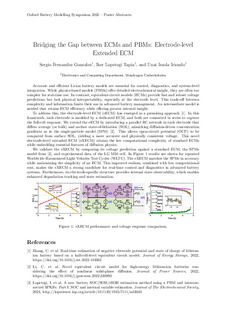
Accurate and efficient Li-ion battery models are essential for control, diagnostics, and system-level integration. While physics-based models (PBMs) offer detailed electrochemical insight, they are often too complex for real-time use. In contrast, equivalent-circuit models (ECMs) provide fast and robust voltaje predictions but lack physical interpretability, especially at the electrode level. This trade-off between complexity and information limits their use in advanced battery management. An intermediate model is needed that retains ECM efficiency while offering greater internal insight. To address this, the electrode-level ECM (eECM) has emerged as a promising approach [1]. In this framework, each electrode is modeled by a dedicated ECM, and both are connected in series to capture the full-cell response. We extend the eECM by introducing a parallel RC network in each electrode that differs average (or bulk) and surface state-of-lithiation (SOL), mimicking diffusion-driven concentration gradients as in the single-particle model (SPM) [2]. This allows open-circuit potential (OCP) to be computed from surface SOL, yielding a more accurate and physically consistent voltage. This novel electrode-level extended ECM (eXECM) retains the low computational complexity of standard ECMs while embedding essential features of diffusion physics. We validate the eXECM by comparing its voltage prediction against a standard ECM, the SPMe model from [3], and experimental data of the LG M50 cell. In Figure 1 results are shown for repeated Worldwide Harmonized Light Vehicles Test Cycles (WLTC). The eXECM matches the SPMe in accuracy while maintaining the simplicity of an ECM. This improved realism, combined with low computational cost, makes the eXECM a strong candidate for real-time control and diagnostics in advanced battery systems. Furthermore, its electrode-specific structure provides internal state observability, which enables enhanced degradation tracking and state estimation. [-]