

Compartir


Guarda la referencia




Título
Influence of contact resistance on thermal behavior of pouch-cell battery modules under partial direct liquid cooling: A numerical studyAutor-a

Otras instituciones
https://ror.org/03vgz7r63Versión
Version publicadaTipo de documento
ArtículoIdioma
InglésDerechos
© The Author(s)Acceso
Acceso abiertoVersión de la editorial
https://doi.org/10.1016/j.csite.2026.108098Publicado en
Case Studies in Thermal Engineering 2025 Vol. 82. N. art. 108098Editorial
ElsevierPalabras clave
ODS 7 Energía asequible y no contaminante
ODS 9 Industria, innovación e infraestructura
Direct liquid cooling
Lithium-ion battery thermal management ... [+]
ODS 9 Industria, innovación e infraestructura
Direct liquid cooling
Lithium-ion battery thermal management ... [+]
ODS 7 Energía asequible y no contaminante
ODS 9 Industria, innovación e infraestructura
Direct liquid cooling
Lithium-ion battery thermal management
Pouch-cell module
Contact resistance heating
Numerical case study
CFD
Electric vehicle battery design [-]
ODS 9 Industria, innovación e infraestructura
Direct liquid cooling
Lithium-ion battery thermal management
Pouch-cell module
Contact resistance heating
Numerical case study
CFD
Electric vehicle battery design [-]
Materia (Tesauro UNESCO)
Mecánica de fluidosClasificación UNESCO
Mecánica de fluídosResumen
Direct liquid cooling (DLC) using dielectric fluids is emerging as a highly effective strategy for thermal management in high-performance lithium-ion battery systems, particularly under demanding oper ... [+]
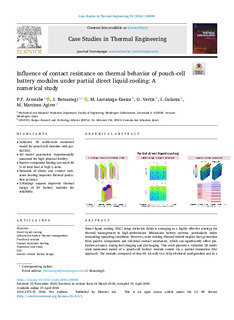
Direct liquid cooling (DLC) using dielectric fluids is emerging as a highly effective strategy for thermal management in high-performance lithium-ion battery systems, particularly under demanding operating conditions. However, most existing thermal models neglect heat generation from passive components and electrical contact resistances, which can significantly affect prediction accuracy during fast charging and discharging. This work presents a validated 3D multi-scale numerical model of a pouch-cell battery module cooled via a partial immersion DLC approach. The module, composed of four 60 Ah cells in a 2s2p electrical configuration and in a 1s4p hydraulic arrangement, is modeled using a multi-domain framework that integrates electrochemical and thermal phenomena. All model input parameters were experimentally measured in our laboratory, ensuring high physical fidelity. Importantly, the model incorporates ohmic heating in passive components and heat generated by contact resistance, factors often overlooked in existing literature. Validation against experimental measurements demonstrates high accuracy in predicting both transient and steady-state temperature profiles, including spatial temperature distributions within and between cells. Results reveal that passive component heating can momentarily account for up to 46 % of total heat generation under high C-rate charge-discharge cycles, while contact resistance contributes up to 12 % during semi-fast charging. These findings highlight the critical need to include these sources in thermal models to ensure accurate predictions and support design improvements. The proposed approach offers valuable insights for enhancing thermal performance, reliability, and safety of pouch-cell battery modules in electric vehicle applications. [-]
Financiador
Gobierno VascoPrograma
Elkartek 2025Grupos de Investigación
Número
KK-2025/00094IT1505-22
Proyecto
Sistemas avanzados de baterías para movilidad eléctrica - tecnologías habilitadoras para sistemas de almacenamiento de energía en base a baterías de estado sólido (SSB) (BAT4ME25)Mecánica de Fluidos
Colecciones
- Artículos - Ingeniería [930]
El ítem tiene asociados los siguientes ficheros de licencia:

Excepto si se señala otra cosa, la licencia del ítem se describe como CC BY