Environmental assessment of a hot sauce: Involving stakeholders in the development of new food products
| dc.rights.license | Attribution 4.0 International | * |
| dc.contributor.author | Torán Pereg, Paula | |
| dc.contributor.author | Novoa, Stefani | |
| dc.contributor.author | VÁZQUEZ-ARAÚJO, LAURA | |
| dc.contributor.author | Pardo, Guillermo | |
| dc.date.accessioned | 2026-06-02T08:55:33Z | |
| dc.date.available | 2026-06-02T08:55:33Z | |
| dc.date.issued | 2025 | |
| dc.identifier.issn | 0959-6526 | en |
| dc.identifier.uri | https://hdl.handle.net/20.500.11984/14472 | |
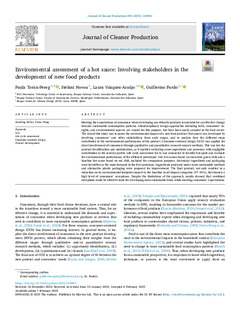
| dc.description.abstract | Meeting the expectations of consumers when developing eco-friendly products is essential for an effective change towards sustainable consumption patterns. Interdisciplinary design approaches including both, consumers’ insights, and environmental aspects, are crucial for this purpose, but have been rarely adopted in the food sector. The aim of this study was to assess the environmental impact of a new food product (hot sauce) eco-developed by involving consumers’ and other stakeholders from early stages, and to analyze how the different steps contributed to the environmental performance of the product. Consumer-centered design (CCD) was applied for direct involvement of consumers through qualitative and quantitative research sensory methods. This was key for product identification and optimization, as it enabled excluding some ingredients and processes with negligible contribution to the sensory profile. Life cycle assessment (LCA) was conducted to identify hot-spots and evaluate the environmental performance of the different prototypes: two hot sauces based on discarded green chili and a baseline hot sauce based on red chili, included for comparison purposes. Secondary ingredients and packaging were identified as the main hotspots in the first prototype. Ingredients produced under more sustainable methods and alternative plastic packaging were proposed for improvement. The final product, not only resulted in a reduction on its environmental footprint respect to the baseline in all impact categories (57–91%), but showed a high level of consumers’ acceptance. Despite the limitations of the approach, results showed that combined disciplines could be effective tools for developing more sustainable foods while meeting consumers’ expectations. | en |
| dc.language.iso | eng | en |
| dc.publisher | Elsevier | en |
| dc.rights | © 2025 The Authors | en |
| dc.rights.uri | http://creativecommons.org/licenses/by/4.0/ | * |
| dc.subject | LCA | en |
| dc.subject | Life cycle assessment | en |
| dc.subject | Consumer-centered design | en |
| dc.subject | Product development | en |
| dc.title | Environmental assessment of a hot sauce: Involving stakeholders in the development of new food products | en |
| dcterms.accessRights | http://purl.org/coar/access_right/c_abf2 | en |
| dcterms.source | Journal of Cleaner Production | en |
| local.contributor.group | sostenibilidad | es |
| local.description.peerreviewed | true | en |
| local.identifier.doi | https://doi.org/10.1016/j.jclepro.2025.144983 | en |
| local.source.details | Vol. 494, n. art. 144983 | en |
| oaire.format.mimetype | application/pdf | en |
| oaire.file | $DSPACE\assetstore | en |
| oaire.resourceType | http://purl.org/coar/resource_type/c_6501 | en |
| oaire.version | http://purl.org/coar/version/c_970fb48d4fbd8a85 | en |
| oaire.funderName | Gobierno Vasco | en |
| oaire.funderIdentifier | https://ror.org/00pz2fp31 / http://data.crossref.org/fundingdata/funder/10.13039/501100003086 | en |
| oaire.funderIdentifier | https://ror.org/038jjxj40 / http://data.crossref.org/fundingdata/funder/10.13039/501100010198 | en |
| oaire.fundingStream | BERC 2022–2024 | en |
| oaire.fundingStream | Unidad de Excelencia María de Maeztu | en |
| oaire.awardNumber | CEX2021-001201-M | en |
Files in this item
This item appears in the following Collection(s)

Except where otherwise noted, this item's license is described as Attribution 4.0 International