Quercus robur and pyrenaica: The Potential of Wild Edible Plants for Novel Kombuchas
| dc.rights.license | Attribution 4.0 International | * |
| dc.contributor.author | Estrada Korta, Olaia | |
| dc.contributor.author | Gayoso, Lucía | |
| dc.contributor.author | Ortega, Gorka | |
| dc.contributor.author | del Noval López de Montenegro, Blanca | |
| dc.date.accessioned | 2026-05-27T13:29:45Z | |
| dc.date.available | 2026-05-27T13:29:45Z | |
| dc.date.issued | 2023 | |
| dc.identifier.issn | 2311-5637 | en |
| dc.identifier.uri | https://hdl.handle.net/20.500.11984/14461 | |
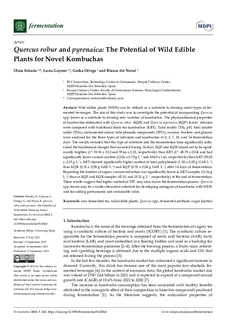
| dc.description.abstract | Wild edible plants (WEPs) can be utilised as a substrate to develop novel types of fermented beverages. The aim of this study was to investigate the potential of incorporating Quercus spp. leaves as a substrate to develop new varieties of kombuchas. The physicochemical properties of kombuchas elaborated with Quercus robur (KQR) and Quercus pyrenaica (KQP) leaves’ infusion were compared with traditional black tea kombuchas (KBT). Total acidity (TA), pH, total soluble solids (TSSs), instrumental colour, total phenolic compounds (TPCs), sucrose, fructose, and glucose were analysed for the three types of infusions and kombuchas at 0, 3, 7, 10, and 14 fermentation days. The results revealed that the type of substrate and the fermentation time significantly influenced the biochemical changes that occurred during 14 days. KQP and KQR turned out to be significantly brighter (L*: 53.91 ± 0.12 and 55.66 ± 0.23, respectively) than KBT (L*: 48.79 ± 0.34) and had significantly lower sucrose content (22.06 ± 0.79 g L−1 and 45.69 ± 1.61, respectively) than KBT (59.28 ± 2.25 g L−1). KBT showed significantly higher content of total polyphenols (1.50 ± 0.05 g GAE L−1) than KQR (0.76 ± 0.09 g GAE L−1) and KQP (0.51 ± 0.04 g GAE L−1) after 14 days of fermentation. Regarding the kinetics of sugars, sucrose reduction was significantly lower in KBT samples (11.36 g L−1) than in KQP and KQR samples (47.01 and 28.31 g L−1, respectively) at the end of fermentation. These results suggest that higher content of TPC may slow down the fermentation process. Quercus spp. leaves may be a viable alternative substrate for developing analogues of kombucha with WEPs and for adding gastronomic and sustainable value. | en |
| dc.language.iso | eng | en |
| dc.publisher | MDPI | en |
| dc.rights | © 2023 by the authors | en |
| dc.rights.uri | http://creativecommons.org/licenses/by/4.0/ | * |
| dc.subject | new fermented tea | en |
| dc.subject | wild edible plants | en |
| dc.subject | Quercus spp. | en |
| dc.subject | fermented methods | en |
| dc.subject | sugar kinetics | en |
| dc.title | Quercus robur and pyrenaica: The Potential of Wild Edible Plants for Novel Kombuchas | en |
| dcterms.accessRights | http://purl.org/coar/access_right/c_abf2 | en |
| dcterms.source | Fermentation | en |
| local.contributor.group | innovacion culinaria | es |
| local.description.peerreviewed | true | en |
| local.identifier.doi | https://doi.org/10.3390/fermentation9100863 | en |
| local.rights.publicationfee | APC | en |
| local.source.details | n. 10, vol. 9, n. art. 863 | en |
| oaire.format.mimetype | application/pdf | en |
| oaire.file | $DSPACE\assetstore | en |
| oaire.resourceType | http://purl.org/coar/resource_type/c_6501 | en |
| oaire.version | http://purl.org/coar/version/c_970fb48d4fbd8a85 | en |
| oaire.funderName | Gobierno Vasco | en |
| oaire.funderIdentifier | https://ror.org/00pz2fp31 / http://data.crossref.org/fundingdata/funder/10.13039/501100003086 | en |
Files in this item
This item appears in the following Collection(s)

Except where otherwise noted, this item's license is described as CC BY