Biological, Social, and Structural Gaps in Physical Activity: Age, Gender and Sport in Basque Youth
| dc.contributor.author | Albisua, Neritzel | |
| dc.contributor.other | Angulo Garay, Garazi | |
| dc.contributor.other | Río, Xabier | |
| dc.contributor.other | Fernández López, Juan Ramón | |
| dc.contributor.other | Sánchez Isla, José Ramón | |
| dc.contributor.other | Larrinaga-Undabarrena, Arkaitz | |
| dc.date.accessioned | 2026-10-08T09:02:49Z | |
| dc.date.available | 2026-10-08T09:02:49Z | |
| dc.date.issued | 2026-06-30 | |
| dc.identifier.issn | 2386-4095 | en |
| dc.identifier.other | https://katalogoa.mondragon.edu/janium-bin/janium_login_opac.pl?find&ficha_no=204056 | en |
| dc.identifier.uri | https://hdl.handle.net/20.500.11984/14669 | |
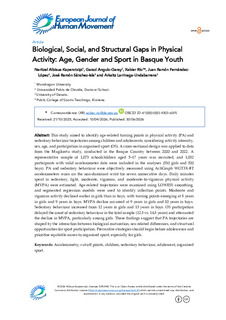
| dc.description.abstract | This study aimed to analyse turning points in physical activity (PA) trajectories among children and adolescents according to intensity, age, gender, and participation in organised sport (OS). Methods: A cross-sectional design was applied to a representative sample of 1,073 Basque schoolchildren (537 girls, 536 boys) aged 5 to 18 years. PA was objectively measured using ActiGraph WGT3X-BT accelerometers for seven consecutive days. Trend smoothing (LOWESS) and segmented regression models identified turning points. Results: Declines in moderate and vigorous activity appeared earlier in girls (8 years) than in boys (9 years). Sedentary behaviour increased earlier in girls (12 years) than in boys (13 years). Participation in OS significantly delayed the onset of sedentary behaviour (12.3 vs. 14.8 years) and attenuated MVPA decline, especially in girls. Conclusions: Disparities in PA trajectories are shaped by biological maturation, gender, and structural opportunities. These findings underscore the need for targeted, equity-focused interventions to sustain PA during adolescence. | es |
| dc.language.iso | eng | en |
| dc.publisher | Spanish Sport Science Association | en |
| dc.rights | © 2026 Albisua-Kaperotxipi, licensee EURJHM | en |
| dc.rights.uri | https://creativecommons.org/licenses/by/4.0/ | en |
| dc.subject | Accelerometry | en |
| dc.subject | Cut-off points | en |
| dc.subject | Children | en |
| dc.subject | Sedentary behaviour | en |
| dc.subject | Adolescent | en |
| dc.subject | Organised sport | en |
| dc.title | Biological, Social, and Structural Gaps in Physical Activity: Age, Gender and Sport in Basque Youth | en |
| dcterms.accessRights | http://purl.org/coar/access_right/c_abf2 | en |
| dcterms.source | European Journal of Human Movement | en |
| local.contributor.group | Hezkuntza berrikuntza | eu |
| local.contributor.group | Innovación educativa | es |
| local.contributor.group | Hezkuntza prozesuak | eu |
| local.contributor.group | Procesos educativos | es |
| local.description.peerreviewed | true | en |
| local.description.publicationfirstpage | 43 | en |
| local.description.publicationlastpage | 55 | en |
| local.identifier.doi | https://doi.org/10.21134/eurjhm.2026.56.3 | en |
| local.contributor.otherinstitution | https://ror.org/02z749649 | es |
| local.contributor.otherinstitution | https://ror.org/00ne6sr39 | es |
| local.contributor.otherinstitution | Kirolene: Kirol Irakaskuntzen Ikastetxe Publikoa | eu |
| local.source.details | 56, 43-55. | en |
| oaire.format.mimetype | application/pdf | en |
| oaire.file | $DSPACE\assetstore | en |
| oaire.resourceType | http://purl.org/coar/resource_type/c_6501 | en |
| oaire.version | http://purl.org/coar/version/c_970fb48d4fbd8a85 | en |
| dc.unesco.tesauro | http://vocabularies.unesco.org/thesaurus/concept61 | en |
Item honetako fitxategiak
Item hau honako bilduma honetan/hauetan agertzen da
-
Artikuluak - Hezkuntza [184]

Bestelakorik adierazi ezean, itemaren baimena horrela deskribatzen da: CC BY