Bridging bricolage and effectuation: The mediating role of innovative behavior in student entrepreneurial action under resource constraints
| dc.rights.license | Attribution 4.0 International | * |
| dc.contributor.author | Manzi Puertas, Mario A. | |
| dc.contributor.author | Agirre Aramburu, Izaskun | |
| dc.contributor.author | Urzelai, Berrbizne | |
| dc.contributor.author | López-Pérez, Saín Milena | |
| dc.date.accessioned | 2025-12-04T09:19:26Z | |
| dc.date.available | 2025-12-04T09:19:26Z | |
| dc.date.issued | 2025 | |
| dc.identifier.issn | 2299-7075 | en |
| dc.identifier.other | https://katalogoa.mondragon.edu/janium-bin/janium_login_opac.pl?find&ficha_no=200480 | en |
| dc.identifier.uri | https://hdl.handle.net/20.500.11984/14001 | |
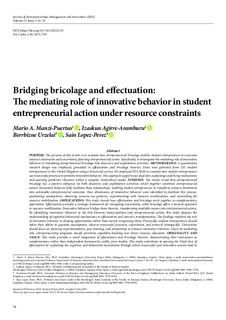
| dc.description.abstract | PURPOSE: The purpose of this article is to examine how entrepreneurial bricolage enables student entrepreneurs to overcome resource constraints and uncertainty, fostering entrepreneurial action. Specifically, it investigates the mediating role of innovative behavior in translating entrepreneurial bricolage into discovery and exploitation activities. METHODOLOGY: A quantitative research design was employed, grounded in effectuation and bricolage theories. Data were gathered from 101 student entrepreneurs in the United Kingdom using a structured survey. We employed PLS-SEM to examine how student entrepreneurs use resourceful practices to promote innovative behavior. This approach supports our dual aim: explaining underlying mechanisms and assessing predictive relevance within a complex, hierarchical model. FINDINGS: The results reveal that entrepreneurial bricolage has a positive influence on both discovery and exploitation activities, which together constitute entrepreneurial action. Innovative behavior fully mediates these relationships, enabling student entrepreneurs to transform resource limitations into actionable entrepreneurial outcomes. Four dimensions of innovative behavior were identified to facilitate this process: questioning assumptions, observing resource-use patterns, experimenting with resource combinations, and networking for resource mobilization. IMPLICATIONS: This study reveals how effectuation and bricolage work together as complementary approaches. Effectuation provides a strategic framework for navigating uncertainty, while bricolage offers a tactical approach to resource mobilization. Innovative behavior bridges these theories, transforming available means into entrepreneurial action. By identifying innovative behavior as the link between resourcefulness and entrepreneurial action, this study deepens the understanding of cognitive-behavioral mechanisms in effectuation and resource transformation. The findings reinforce the role of innovative behavior in shaping opportunities rather than merely recognizing them. Practically, student entrepreneurs should refine their ability to question assumptions, observe resourceful practices, experiment, and network strategically. Universities should focus on fostering experimentation, peer learning, and mentorship to enhance innovative behavior. Given its mediating role, entrepreneurship programs should prioritize capability-building over direct resource allocation. ORIGINALITY AND VALUE: This study provides a novel integration of effectuation and bricolage theories, demonstrating their interaction as complementary rather than independent frameworks, unlike prior studies. This study contributes to opening the ‘black box’ of effectuation by explaining the cognitive and behavioral mechanisms through which resourceful and innovative actions lead to entrepreneurial action, and by evaluating their ability to predict entrepreneurial outcomes. Additionally, it extends bricolage theory by highlighting its behavioral dimensions, shifting its focus from improvisation to a dynamic problem-solving process. These contributions provide a richer theoretical perspective on how student entrepreneurs navigate uncertainty and leverage limited resources to drive venture creation. | en |
| dc.language.iso | eng | en |
| dc.rights | © Egileak | en |
| dc.rights.uri | http://creativecommons.org/licenses/by/4.0/ | * |
| dc.subject | entrepreneurial bricolage | en |
| dc.subject | effectuation theory | en |
| dc.subject | innovative behavior | en |
| dc.subject | student entrepreneurship | en |
| dc.subject | resource constraints | en |
| dc.subject | entrepreneurial action | en |
| dc.subject | discovery and exploitation | en |
| dc.subject | cognitive-behavioral mechanisms | en |
| dc.subject | means-driven logic | en |
| dc.subject | resource mobilization | en |
| dc.title | Bridging bricolage and effectuation: The mediating role of innovative behavior in student entrepreneurial action under resource constraints | en |
| dcterms.accessRights | http://purl.org/coar/access_right/c_abf2 | en |
| dcterms.source | Journal of Entrepreneurship, Management and Innovation 21(3) | en |
| local.description.peerreviewed | true | en |
| local.description.publicationfirstpage | 54 | en |
| local.description.publicationlastpage | 76 | en |
| local.identifier.doi | https://doi.org/10.7341/20252133 | en |
| local.embargo.enddate | 2025 | |
| local.contributor.otherinstitution | https://ror.org/00wvqgd19 | |
| local.source.details | 2025 | en |
| oaire.format.mimetype | application/pdf | en |
| oaire.file | $DSPACE\assetstore | en |
| oaire.resourceType | http://purl.org/coar/resource_type/c_6501 | en |
| oaire.version | http://purl.org/coar/version/c_970fb48d4fbd8a85 | en |
| dc.unesco.tesauro | http://vocabularies.unesco.org/thesaurus/concept5674 | en |
| dc.unesco.clasificacion | http://skos.um.es/unesco6/5311 | en |
Files in this item
This item appears in the following Collection(s)

Except where otherwise noted, this item's license is described as CC BY